If you’ve ever worked in data centers, telecom infrastructure, or high-density network deployments, you’ve probably heard the term MPO fiber cable thrown around. And if you’ve had to troubleshoot a connection that just won’t light up—even after double-checking every connector, patch panel, and port—you’ve likely encountered the confusing world of MPO polarity. As a supplier specializing exclusively in MPO/MTP single mode fiber cables, I field this question every single day: “What is the polarity of an MPO single mode fiber cable, and why does it matter so much?” Today, I’m breaking this down in plain terms, no overly dense jargon, and I’ll explain why getting this right can save you weeks of downtime, lost revenue, and frustrated techs. MPO/MTP Single Mode Fiber Cable
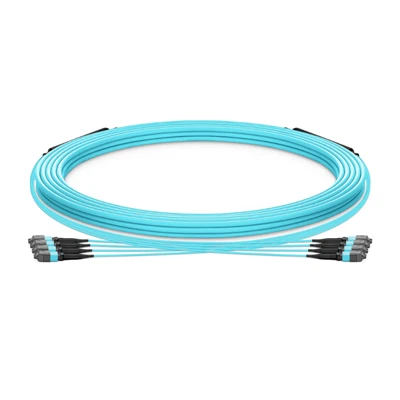
First, let’s start with the basics for anyone new to MPO connectors. Unlike standard LC or SC fiber connectors that only carry 2 fibers each, an MPO (multi-fiber push-on) connector can hold anywhere from 8 to 72 fibers, depending on the type—though for single mode applications, the most common are 12-fiber and 24-fiber MPO cables. That density is why MPO is the go-to for 10G, 40G, and 100G networks, where you need to cram as much throughput into as little space as possible. But here’s the catch: each fiber in an MPO cable isn’t a random strand. For two transceivers to communicate, the transmit (Tx) fiber on one end has to line up exactly with the receive (Rx) fiber on the other end of the link. With standard 2-fiber cables, that’s easy—you plug in LC, and it just works, because there’s only one Tx and one Rx. But with 12 or 24 fibers, if you don’t line them up correctly, none of them work. That’s where MPO polarity comes in.
Polarity, in the simplest terms for MPO single mode cables, is the mapping of fiber positions on one connector end to the matching positions on the opposite end. Think of it like a road map: if you start at Exit 1 on one side of a highway, you need to end up at the correct Exit 1 on the other side, not Exit 12. For MPO, the connector’s internal pins and keyways define which fiber is in which position, and the standard defines exactly how those positions should align to pass a signal. But here’s the thing: there isn’t just one type of MPO polarity. That’s where most people get tripped up. The three main polarity types you’ll encounter for single mode MPO cables are Type A, Type B, and Type BA (sometimes called Type C, though I’ve found BA is more universally used in enterprise networking).
Let’s break each one down so it makes sense, especially for single mode, which behaves a little differently than multimode when it comes to polarity (single mode has a smaller core, so position alignment is even more critical for maintaining signal integrity). Type A is the most straightforward, and it’s what most people learn first. For a 12-fiber Type A MPO cable, the fiber positions on the front of the female connector are numbered 1 to 12, left to right when you’re holding the connector key facing up (the key is the plastic tab that prevents you from plugging it in backward). For Type A, fiber 1 on the transmit end connects directly to fiber 1 on the receive end, fiber 2 to 2, and so on, all the way to 12 to 12. That’s a straight-through polarity. It works for simple point-to-point links, like connecting a switch’s MPO uplink port directly to a patch panel’s MPO port. But Type A has a big limitation when it comes to higher-density setups, like when you’re fanouting an MPO cable to 12 LC connectors (a common practice for 40GBASE-LR4, which uses 4 fibers per direction). If you use Type A polarity for a fanout cable, the Tx fibers will not line up with the correct Rx fibers on the LC side, because the fanout breakout converts the MPO 12 positions into individual LC cables, each with their own Tx and Rx pair.
That’s why Type B was developed. Type B polarity swaps the Tx and Rx fiber positions to make fanouts work seamlessly. For a 12-fiber Type B MPO cable, fiber 1 on the transmit end connects to fiber 12 on the receive end, fiber 2 to 11, and this reverse pairing continues all the way to fiber 12 connecting to fiber 1. This is the standard polarity used for parallel optics, like QSFP transceivers, because when you fan out the Type B cable to 12 LC connectors, each fiber ends up in the correct Tx/Rx pair. For example, the four fibers needed for 40G on one side will line up perfectly with the four fibers needed on the other, no extra adapters or rewiring needed. I’ve seen too many data center techs mix up Type A and Type B when setting up QSFP links, and they end up with half the ports working, or no connectivity at all—costing them hours of troubleshooting time. The third type, Type BA, is a hybrid that’s used for more complex cascaded networks, like when you’re connecting multiple patch panels together and need to avoid excess cable runs. It works by swapping two sets of fibers in the middle of the link, so it maintains compatibility with both Type A and Type B devices, though it’s less common than the first two for single mode applications.
Now, let’s talk about why polarity is even more important for single mode MPO cables vs. multimode. Multimode fiber has a larger core, so it’s a little more forgiving when fibers are slightly misaligned. Single mode has a core diameter of just 9 microns (vs. 50 or 62.5 microns for multimode), so even a tiny shift in fiber position can cause signal loss, increased latency, or even complete link failure. For a 100G single mode link, which relies on four parallel fibers for Tx and four for Rx, misaligned polarity can lead to crosstalk between adjacent fibers, or signal attenuation high enough that the transceiver can’t lock on. I had a customer reach out to me last year with a 10-day outage in their new data center expansion, and when we sent our field tech to test their MPO cables, we found they’d installed Type A polarity when they needed Type B for their QSFP28 single mode transceivers. They’d ordered the wrong polarity cable from a supplier who didn’t label it clearly, and that mistake cost them $120,000 in lost revenue from e-commerce traffic alone. That’s the kind of thing that makes me so passionate about getting polarity right, because it’s not just a technical detail—it’s a business critical one.
Another thing that comes up all the time with MPO polarity is how to test and label cables correctly. When I supply MPO single mode cables, every single one is labeled clearly on both ends with its polarity type and fiber count, plus a unique serial number that matches it to a test report from our in-house lab. Testing polarity before installation is non-negotiable, especially for single mode. You can use an MPO polarity tester, which plugs into both ends of the cable and shows you exactly how the fibers are mapped, or a light source and power meter to check for signal loss at each fiber position. It’s also important to remember that MPO connectors themselves can be keyed different ways—there are Type A keys and Type B keys, which are shaped slightly differently so you can’t accidentally plug a Type B connector into a Type A port. That’s a small feature, but it prevents a lot of polarity mistakes before they even happen.
Let’s also address a common misconception: some people think polarity is just a MPO problem, and that once you plug in a fanout cable, it doesn’t matter anymore. That’s not true. Even after you fan out, the polarity of the original MPO cable is still the foundation of the connection. If your base MPO cable is Type B, the fanout LC pigtails will have Tx fibers on positions 1-4 and Rx on 7-10, for example, so when you plug those into a transceiver’s LC ports, you have to make sure the transceiver is set to match that. If you plug the Rx pigtail into a Tx port, the link won’t work, and that’s a mistake that starts with misconfigured MPO polarity at the source.
Now, as someone who’s been in the MPO single mode cable supply business for over a decade, I’ve seen firsthand how inconsistent polarity labeling across suppliers causes so many issues. Some suppliers label Type A as “straight through” and Type B as “reverse,” while others use their own internal names. That’s why I always tell my customers to ask for a polarity test report with every cable order, not just a part number. The test report will list exactly how each fiber is mapped from end to end, so if you’re working with a third-party installer, you can hand them that document and eliminate any guesswork. For single mode applications, where signal integrity is non-negotiable, this test report is just as important as the cable itself.
I also want to touch on the difference between MPO and MTP polarity, because a lot of people mix those two up. MTP is a brand name of MPO connector made by US Conec, and while MTP connectors follow the same polarity standards as standard MPO connectors, they have a more precise internal ferrule, which reduces signal loss. For single mode, using MTP connectors is often recommended because the tighter alignment means less attenuation, but the polarity rules are identical. So when I say MPO polarity, that applies to MTP cables too—just make sure you confirm the connector type when ordering to get the right fit for your ports.
What about for custom MPO single mode cables? If you need a non-standard polarity for a specific network layout, I can design and manufacture custom MPO cables with any polarity type, as long as you provide the required mapping. I’ve done that for enterprise data centers, telecom carriers, and even research facilities that have unique network topologies. The key here is to communicate your exact needs upfront—don’t assume that all MPO cables are the same, because a 12-fiber Type B cable for a QSFP link is completely different from a 12-fiber Type A cable for a point-to-point single mode switch connection.
Let’s wrap this up with a quick checklist to avoid polarity mistakes for MPO single mode cables, so you can reference this next time you’re ordering or installing:
- Confirm your network equipment’s required polarity type (check your transceiver or switch manual—most will specify Type A or Type B for single mode applications)
- Always order cables with clear polarity labeling and a test report from a reputable supplier
- Test polarity before installation, especially for critical links
- Double-check connector keys to match your polarity type (Type A key for Type A cables, Type B key for Type B cables)
- For fanout setups, confirm that the MPO polarity matches the fanout breakout you’re using

At the end of the day, MPO polarity isn’t a technicality—it’s the foundation of any high-density single mode network. Getting it wrong doesn’t just mean minor signal loss; it means downtime, lost revenue, and hours of troubleshooting that no IT team has time for. If you’re planning a new data center build, upgrading your network to 100G or 400G, or just need to replace old MPO cables that aren’t performing, let’s talk. I can help you select the right polarity type for your application, provide test reports for every order, and make sure your MPO single mode cables work the first time, every time.
Fiber Pigtail References
- Internet Data Center Council. (2021). Best Practices for MPO/MTP Fiber Optic Cabling in High-Density Networks. IDCC Technical White Paper.
- TIA-568-C.3. (2012). Standard for Telecommunications Cabling for Customer Premises, Optical Fiber Components Standards. Telecommunications Industry Association.
- US Conec. (2020). MTP Connector Polarity and Installation Guide for Single Mode Fiber Links. Industry Application Note.
- Optical Internetworking Forum. (2019). Parallel Optics Polarity Standard for 100GBASE-LR4 and 40GBASE-LR4. OIF Technical Implementation Agreement.
Shenzhen Dimi Telecommunications Co., Ltd.
As one of the most professional MPO/MTP single mode fiber cable manufacturers and suppliers in China, our products have good reputation in the market. Please rest assured to wholesale advanced MPO/MTP single mode fiber cable made in China here from our factory. Also, custom service is available.
Address: China
E-mail: sales@dimifiber.com
WebSite: https://www.dimi-fiber.com/
