If you’ve ever stood under a string of outdoor LED lights during a summer backyard cookout, or glanced up at the bright, consistent LED fixtures lining a downtown sidewalk after dark, you’ve probably taken for granted the quiet workhorse keeping those lights on: the LED driver. As a waterproof LED driver supplier who’s been in this space for 12 years, I get that there’s a lot of confusion about whether a driver rated for wet, outdoor environments is actually necessary, or if you can just grab any old driver from an indoor fixture and stick it outside. The short answer? Yes, a waterproof LED driver can absolutely be used outdoors—but the “why” behind that answer is rooted in real-world conditions I’ve seen ruin thousands of drivers over the years, and the practical mistakes that too many contractors and DIYers make that lead to early failures. Waterproof LED Driver
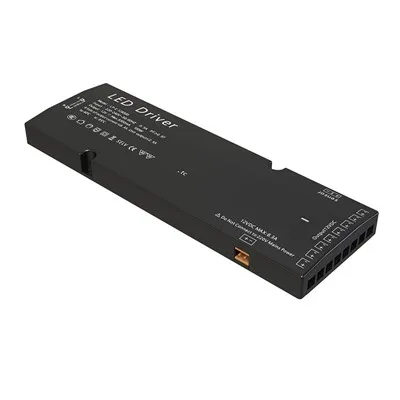
Let’s start with what an LED driver even does, for anyone who might be new to this side of the lighting industry. Unlike old incandescent bulbs, which run on high-voltage AC power straight from the grid, LEDs need a steady, low-voltage DC current to work properly. Too much voltage and you’ll burn out the diode in days; too little and the light will dim, flicker, or have uneven output within weeks. The driver is the component that converts grid AC to the precise DC current LEDs need—so it’s not just a “power cord add-on,” it’s the part that determines how long the entire LED system lasts. Indoor drivers are built for controlled environments: stable room temperature, no constant moisture, no dust or salt spray. Outdoor environments? They’re a totally different ballgame.
I learned this lesson early on, back in 2012, when a contractor client brought me a pile of failed drivers from a set of storefront holiday lights. They’d used standard indoor drivers inside the waterproof casing of the light strings, assuming the outer casing would protect the driver. But what they didn’t account for was condensation. On cold winter nights, when the temperature dropped below freezing, the warm air inside the sealed casing met the cold glass of the bulb, turning to water droplets. The indoor driver had tiny gaps and vents to let heat escape, and over time, that moisture seeped in, corroded the circuit boards, and shorted the driver out. That was the moment I realized waterproof drivers aren’t just a sales pitch—they’re a necessary fix for the hidden forces that destroy outdoor lighting gear.
So what makes an LED driver waterproof, and why is that specific protection non-negotiable for outdoor use? The key here is IP ratings, which are the industry standard for ingress protection. IP stands for Ingress Protection, and the number is split into two parts: the first is for solid particles (like dust, dirt, or bugs), the second is for liquids. For outdoor use, you want a driver with at least an IP65 rating—let me break that down. The “6” means it’s totally dust-tight; no tiny particles can get inside the casing, which is critical for outdoor settings where wind kicks up road grit, construction debris, or even pollen that can clog heat vents. The “5” means it’s protected against low-pressure water jets from any direction—think rain, hose-downs for patio lights, or even water splashing from a sprinkler. Some higher-grade outdoor drivers go up to IP67, which means they can even be submerged in up to 1 meter of water for 30 minutes, perfect for underwater pool lights or dock lighting.
Indoor drivers, by contrast, usually have an IP20 or IP40 rating. IP20 means they’re only protected against large solid objects (like fingers) and no water at all. That’s fine for a ceiling light in your living room, but if you mount that same driver under a patio awning where it gets hit with rain, or above a garage door where snowmelt drips onto it, it’s a ticking time bomb. I’ve also seen drivers mounted on exterior walls that weren’t waterproof, and after a few seasons, the salt spray from coastal areas ate through the uncoated circuit board, turning copper traces to green gunk and killing the driver within a year. Waterproof drivers are coated with a conformal layer—usually epoxy or silicone—that seals every circuit, so moisture can’t reach the delicate electronic parts, even when the driver is constantly exposed to humidity or water.
Another big outdoor challenge that waterproof drivers solve is temperature extremes. Wait, you might be thinking—doesn’t waterproofing have anything to do with heat? It does, actually, and here’s where many people get tripped up. Indoor drivers are designed to dissipate heat through vents, because they don’t have to handle extreme cold or heat for long periods. But outdoor drivers have to survive 120°F summer days in the desert, or -20°F winter nights in the mountains. A good waterproof driver isn’t just sealed—it’s built with thermal management that works outdoors too. The sealed casing doesn’t trap heat because it’s made of high-grade aluminum or plastic that wicks heat away, and the conformal coating doesn’t insulate the circuit so much that it overheats. Back in 2018, we had a customer in Arizona who tried a cheap non-waterproof driver for their streetlight project. By July, the temperature inside their junction box hit 150°F, and the driver’s circuit board warped, leading to flickering lights within 6 months. Swapping to our IP67 waterproof drivers fixed that issue instantly, and they haven’t had a failure in 4 years.
But wait—can you ever use a waterproof driver indoors? Absolutely, and in many cases it’s a smart move. Waterproof drivers are more durable, less likely to get damaged if a pipe leaks or a sprinkler hits it, and they’re often built to handle a wider range of voltage fluctuations, which is common in areas with old electrical grids. We’ve had office building clients switch to waterproof drivers for their warehouse loading dock lights and indoor storage room lights, because the extra protection meant they didn’t have to repair the drivers after occasional water leaks from roof vents. The downside is that waterproof drivers are usually slightly more expensive than indoor drivers, so if you’re never going to be exposed to moisture or extreme temperatures, you don’t need to spend the extra money. But for any application that’s outside, even something as simple as a backyard string light or a garden path light, the small extra cost is nothing compared to the hassle of replacing a driver every year or two.
One common misconception I still hear from contractors is that “if the light fixture is waterproof, the driver doesn’t need to be.” That’s a dangerous assumption, and I’ve seen it go wrong too many times. A waterproof fixture protects the bulb and the lens, but the driver is often mounted inside the fixture’s housing, or in a separate junction box nearby. Even if the fixture is sealed, water can get into the junction box, or condensation can build up inside the housing over time. A few years ago, a contractor client of mine installed 500 outdoor path lights with waterproof fixtures and indoor drivers. By the end of the first winter, 70 of the drivers had failed due to moisture inside the junction boxes. Swapping to waterproof drivers for that job would have cost an extra $1.20 per driver, and saved them from pulling up 700 feet of path lighting to replace the parts. That’s the kind of math I remind every client of: the small upfront cost of a good waterproof driver is way cheaper than emergency repairs or callbacks for outdoor lighting.
Another point to consider is longevity. Most quality waterproof LED drivers have a lifespan of 50,000 to 100,000 hours, compared to 30,000 to 50,000 hours for indoor drivers. That’s because they’re built with higher-grade components—thicker copper traces, better capacitors that don’t fail in extreme temperatures, and the conformal coating that protects against corrosion. For commercial applications, like parking lot lights or highway signage, that longer lifespan means less maintenance and lower long-term costs. I had a city government client in Florida install our IP65 waterproof drivers for their public park lights in 2019. They just did a routine inspection last month, and only 2 of the original drivers had needed replacement in 4 years. Before that, they’d used a different driver that failed at a rate of 15% per year, because it wasn’t rated for the hot, humid Florida summers and occasional heavy rains.
Now, let’s talk about the fine print, because not all waterproof drivers are created equal. You’ll find cheap drivers online that say “waterproof” but only have a basic IP65 rating, or use low-quality conformal coating that peels off after a few seasons. Last year, a homeowner contacted me after buying 20 “waterproof” drivers from a big-box store for their backyard patio lights. Within 8 months, half had failed, and when we tested them, the conformal coating was made of a thin plastic that cracked after being exposed to sun and temperature swings, letting moisture in. When we test our waterproof drivers, we put them through 1,000 hours of salt spray testing to simulate coastal environments, temperature cycling from -40°F to 140°F to mimic four seasons in one year, and jet water testing to make sure they hold up even during heavy storms. That’s the difference between a real waterproof driver and a product that’s just labeled waterproof to make a sale.
So putting it all together: yes, a waterproof LED driver is not just suitable, it’s essential for almost every outdoor lighting application. The outdoor environment brings moisture, temperature swings, dust, and debris that will destroy an unprotected indoor driver in a matter of months, even if you take steps to seal the light fixture. The key is to pick a driver with the right IP rating for your specific use case: IP65 for general outdoor use like path lights, storefront signage, and patio lights; IP67 for submersed applications like pool lights or dock lighting; and always make sure you’re getting a driver from a reputable supplier that uses quality components and has tested their products for real-world outdoor conditions.
If you’re working on an outdoor lighting project—whether it’s a small backyard installation, a commercial parking lot, or a municipal public works project—and you’re not sure which driver is right for you, I’m here to help. We work with contractors, homeowners, and large corporations to find the right waterproof LED driver for any application, with custom options if you have specific needs. Don’t let a cheap, unrated driver ruin your outdoor lighting before it even gets started. Reach out to discuss your project, and we’ll help you find a reliable, long-lasting solution that fits your budget.
Cabinet LED Driver References
- IEC 60529: Degrees of Protection Provided by Enclosures (IP Code)
- Department of Energy: LED Driver Performance Guidelines for Outdoor Lighting Applications
- National Electrical Manufacturers Association (NEMA) Standard for LED Outdoor Lighting Drivers
Dongguan Lanbaoli Intelligent Technology Co., Ltd.
As one of the most professional waterproof led driver manufacturers and suppliers in China, we’re featured by quality products and low price. Welcome to buy advanced waterproof led driver for sale here from our factory. If you have any enquiry about quotation, please feel free to email us.
Address: 10th Floor, Building 32, Golden Town, No. 7 Technology Avenue, Houjie Town, Dongguan City, Guangdong Province
E-mail: anna@lampow.cn
WebSite: https://www.lblsensor.com/
