If you’ve spent any time driving through rural Australia, you’ve likely seen them dotting the landscape: prefabricated farm sheds standing sturdy against sun and wind, ready to store hay, shelter livestock, house machinery, or hold a workshop for farm repairs. As someone who’s been building these structures for 12 years—working side by side with farmers to tailor sheds to their exact needs—I get asked the same question dozens of times a week: “What’s the real cost of a prefabricated farm shed?” It’s not a question with a one-size-fits-all answer, but I’m here to break down the factors that drive pricing, what you’re actually paying for when you work with a reputable supplier, and why cutting corners on cost almost never pays off long-term. Farm Sheds

First, let’s get one thing straight: prefabricated farm sheds aren’t a mass-produced, cookie-cutter product. Sure, you can pick up a generic “standard shed” from a big-box store, but that’s rarely suited to the unique needs of a working farm. A shed that stores 50 round hay bales will look very different from one that houses a 10-tonne tractor or a small herd of goats, and each tweak adds up. Let’s start with the base components that shape the cost: size and purpose.
Size is the most obvious starting point, but it’s not just square metres. For example, a 6×9-metre shed might cost roughly $8,500 in materials alone, while a 12×18-metre structure could jump to $22,000—but that’s just the steel frame and cladding. The purpose of the shed changes everything. If you need a shed for machinery, you’ll need higher eaves (minimum 4 metres for most tractors, up to 6 metres for combine harvesters) and heavier-duty steel framing to support the weight of large equipment. If it’s for livestock, you might add internal pens, concrete flooring, or ventilation systems to keep animals cool in summer and prevent moisture buildup in winter. A hay shed needs extra roof slope to allow rain to run off easily and ventilation to stop mould, which means custom guttering and ridge vents that add a few thousand dollars to the price. I’ve seen farmers underestimate how much space they need, leading them to buy a smaller shed that’s too cramped within a year, so we always recommend building 10-15% extra space than you think you’ll need. That small upfront cost saves you thousands in rework later.
Next, the quality of materials. It’s tempting to go for the cheapest steel you can find, but farm sheds take a beating: they’re exposed to extreme heat, heavy rain, dust, and sometimes even bushfire risks in certain regions. Galvanised steel is non-negotiable for durability, but not all galvanisation is the same. Standard G450 galvanised steel is fine for small, low-stakes sheds, but G550 is stronger and more resistant to corrosion, making it worth the extra $5-10 per square metre for areas with high humidity or salt air (like coastal farms). Some cheap suppliers will offer “pre-galvanised” steel that’s thinner, so it dents easily under hail or heavy snow load, forcing you to replace panels within five years. I had a farmer come to me last year whose $7,000 generic shed had to have half its panels replaced after a single hailstorm, costing him more than double the original price in repairs. The right steel might add 15% to the upfront cost, but it’s a 50+ year lifespan vs a 15-20 year one.
Another big factor is site preparation and foundations. This is where a lot of hidden costs pop up, and it’s also where we see the most mistakes made by farmers who try to cut corners. Prefabricated sheds are designed to be assembled quickly, but they still need a solid foundation. For most flat, well-drained sites, a concrete slab is the gold standard—it’s easy to clean, supports heavy machinery, and prevents weeds and pests from getting in. A 12×18-metre concrete slab can add $12,000 to $18,000, depending on soil type and accessibility. If your site is on a slope, or has poor drainage, you might need to excavate and level the ground, add drainage trenches, or use concrete piers instead of a slab. I once worked with a farmer who tried to build his shed on a low-lying, waterlogged site without proper drainage; within two years, the shed’s frame had shifted, and the doors wouldn’t close. Fixing that cost him $10,000, on top of the original shed price. At our company, we always include a site assessment as part of the quote—we come out to your farm, check soil conditions, measure access for delivery trucks and cranes, and account for any extra work before we finalise a price, so there are no surprise fees down the line.
Delivery and assembly are two more costs that are often overlooked. A prefabricated shed is made in panels and frames in a factory, then delivered to your site and assembled by our team of certified installers. The cost of delivery depends on how far your farm is from our workshop; if you’re within 200 kilometres, delivery might be $500-$1,500, but for remote properties, that can jump to $3,000 or more. Assembly is another area where you get what you pay for. Some suppliers will offer “self-assembly kits” for a few thousand dollars less, but unless you’re experienced with building large structures, you’re asking for trouble. Sheds require precise alignment—even a 5-centimetre shift in the frame can throw off the doors, guttering, and structural integrity. We’ve seen self-assembled sheds that leaked so badly during rain that stored hay rotted, costing their owners $20,000 in lost feed. Our installation team is fully insured, has decades of experience, and we back our work with a 10-year structural warranty, so you know the shed will stand up to whatever the farm throws at it. That peace of mind is worth the extra cost of professional assembly.
Wait, but what about the small, optional extras that make a farm shed useful? Things like roller doors (instead of traditional doors, which are easier for tractors to hit), side panels that can be removed for extra space during harvest, LED lighting for working after dark, or storage lofts for tools and seed. Each of these adds a little to the price, but they’re often non-negotiable for modern farms. A set of two 4-metre roller doors, for example, costs around $3,000, but it saves you from having to modify the shed later when you need to move large equipment. We also offer custom features like integrating a small office or break room into the shed, which is perfect for farmers who want a dry, secure space to manage paperwork without going back to the farmhouse. It’s these little tweaks that turn a basic storage structure into a functional, multi-purpose space that grows with your farm.
Now, let’s talk about the hidden costs of going with an unvetted supplier. I’ve seen too many farmers choose a cheaper quote only to find that the supplier cuts corners on materials, doesn’t include proper site preparation, or disappears halfway through the job, leaving them with a half-built structure and no recourse. A reputable supplier will provide a detailed, transparent quote that breaks down every cost: materials, delivery, assembly, site work, and any extras, plus a clear warranty. They’ll also have references from local farmers who can speak to the quality of their work. We often get farmers coming to us after a bad experience with another supplier, saying “I paid $10,000 for a shed that’s already leaking and the door won’t open.” That’s a false economy. Over the 50-year lifespan of a farm shed, the difference between a $20,000 quality shed and a $12,000 cheap one is roughly $160 a year—less than the cost of a single bale of hay. The peace of mind, durability, and functionality of a quality shed is irreplaceable.
So, to wrap this up: the cost of a prefabricated farm shed ranges from as little as $7,500 for a small, basic 6×9-metre storage shed (materials only, no installation) up to $50,000 or more for a large, customised 18×30-metre structure with concrete flooring, roller doors, and ventilation for livestock. But the real cost isn’t just the upfront price—it’s the long-term durability, functionality, and support you get from a supplier that understands farming.
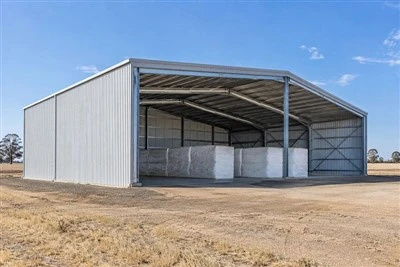
If you’re ready to get a clear, no-obligation quote for your farm shed, or you have questions about size, materials, or site preparation, get in touch with our team to arrange a site visit. We’ll walk your property with you, talk through your needs, and make sure you get a shed that works for your farm, not just a price tag that fits a budget.
Sheds References
- Rural Building Industry Australia. (2022). Prefabricated Farm Sheds: Durability and Cost Benchmarks. National Farmers Federation.
- NSW Department of Primary Industries. (2021). Farm Infrastructure Guide: Shed Design and Site Preparation. State Government of New South Wales.
- Australian Steel Institute. (2020. Galvanised Steel Standards for Rural Structures. Australian Construction Services.
- The Australian Farm Journal. (2023). Common Pitfalls in Farm Shed Construction: A Guide for Farmers. Rural Media Australia.
- Structural Engineers Association of Australia. (2021). Load Requirements for Rural Sheds in Extreme Weather Zones. National Engineering Publication.
MBA Building Solutions Pty Ltd
MBA Building Solutions Pty Ltd is one of the most professional farm sheds suppliers and builders in Australia. We are committed to providing customized building solutions for residential, commercial, industrial and agricultural applications. Welcome to buy durable farm sheds at competitive price here! Also, quotation is available.
Address: 32 Leonard Crescent, Brendale QLD 4500
E-mail: tenders@mbabuildings.com
WebSite: https://www.mbabs.com.au/
