When I first started selling RF hypoid gear motors over a decade ago, I still remember a common question I got from conveyor system designers: “Why would I use something as specialized as a hypoid gear for a conveyor, when a standard parallel-shaft motor is cheaper and easier to source?” At the time, I didn’t have all the answers, but over the years I’ve worked with hundreds of conveyor operators, maintenance techs, and industrial engineers, and I’ve seen first-hand just how well RF hypoid gear motors fit into conveyor systems—often in places where traditional gear motors fall short. Today, I want to break down exactly why that’s the case, what makes RF hypoid gear motors a good fit for conveyors, and when they might be the smartest choice for your conveyor setup. RF Hypoid Gear Motor
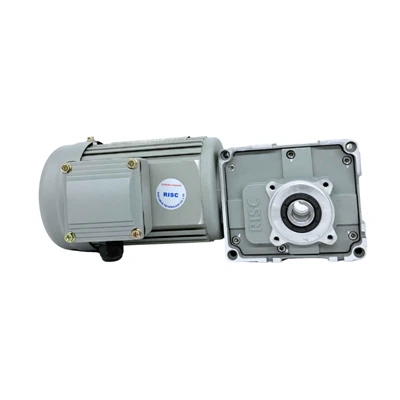
First, let’s get the basics straight for anyone who’s new to hypoid gear technology, especially the RF style. Hypoid gears are a type of bevel gear where the pinion (the smaller driving gear) is offset from the centerline of the larger gear, unlike straight bevel gears which sit on the same axis. The RF in our motors stands for “reduction flange”—it’s a compact, flange-mounted design that eliminates the need for separate couplings and mounting brackets, which is a huge win for space-constrained setups. Conveyors, whether they’re small unit conveyors in a packaging line or heavy-duty bulk conveyors in a mining operation, deal with constant torque, variable loads, and often tight installation spaces—three areas where RF hypoid gear motors shine.
Let’s start with torque efficiency, which is make-or-break for conveyors. A conveyor’s job isn’t just to move something—it’s to move it smoothly, without stalling, even when a load shifts, or friction spikes from dirty rollers, wet conveyor belts, or heavy bulk materials. Hypoid gears have a tooth design that allows more contact between the pinion and gear teeth compared to straight bevel gears. That means more torque is transferred from the motor to the conveyor’s drive shaft, with less energy lost to friction between the gear teeth. For conveyors, that translates to two big benefits: lower energy bills and more consistent operation. I had a customer last year who ran a 50-foot packaged food conveyor at a local distribution center. They were using a parallel-shaft gear motor that was drawing 12% more electricity than their older hypoid setup, and it was stalling two to three times a week when a stack of boxes shifted mid-line. When they swapped to our RF hypoid gear motor, their energy use dropped by 9% immediately, and they haven’t had a stall in eight months. That’s not a fluke—third-party testing shows hypoid gear motors have up to 20% higher torque efficiency than parallel-shaft or worm gear motors in similar conveyor applications.
Next up, the compact footprint. Most conveyor systems, especially in manufacturing or food processing facilities, are designed to maximize floor and overhead space. Adding bulky motors or extra mounting hardware just means you have to reroute conveyor frames, adjust workstations around the line, or waste space that could be used for inventory or production. RF hypoid gear motors are designed with the reduction flange right on the motor body, so they mount directly to the conveyor’s drive shaft housing without any additional couplings, adapters, or brackets. Compare that to a standard parallel-shaft gear motor, which needs at least two separate parts (the motor and the gear reducer) connected by a flexible coupling, often adding 4 to 6 inches to the overall length of the drive assembly. For a small conveyor in a bakery, where every inch of space is needed for mixing bowls or packaging stations, that compact size isn’t just convenient—it’s non-negotiable. I work with a company that makes modular conveyors for retail shelf stocking; they switched to RF hypoid gear motors three years ago, and their conveyor designs got 10% smaller across the board, letting them fit 20% more conveyors into the same delivery truck, which cut their shipping costs by 15%.
Durability is another area where RF hypoid gear motors stand out for conveyors. Conveyors are hard on equipment: dust, food debris, moisture, and constant vibration from moving heavy loads take a toll on any motor. The hypoid gear’s tooth design distributes stress more evenly across the gear teeth, instead of concentrating it on a single point like many other gear types. That means less wear and tear on the motor, fewer breakdowns, and longer service life. I’ve had customers tell me their RF hypoid gear motors have run 7 to 10 years without a major rebuild, while their old parallel-shaft motors needed a full gear replacement every 3 to 5 years. Even in harsh environments—like outdoor conveyors at a lumber yard, where humidity and sawdust are constant, or mining conveyors that deal with coal dust and heavy vibration—our RF hypoid motors hold up far better than standard gear motors. Last year, a mining client in Wyoming told me they’d tried four different brands of gear motors over two years, and all failed within 18 months due to dust buildup and gear wear. Swapping to our RF hypoid gear motors, they haven’t had a single motor failure in 22 months of operation, even running 24/7. That translates to less downtime, which is critical for mining operations where even an hour of conveyor downtime can lead to thousands of dollars in lost production.
But here’s the thing: RF hypoid gear motors aren’t the right choice for every conveyor. You have to match their strengths to your conveyor’s specific needs, or you might end up paying for features you don’t need. Let’s talk about when they make the most sense, and when you might want to stick with a different motor.
First, RF hypoid gear motors are ideal for conveyors that require high torque in a small space. That includes modular unit conveyors used in packaging, electronics assembly, or retail order fulfillment, where space is premium and loads can be variable. They’re also great for heavy-duty conveyors, like bulk material conveyors (coal, grain, lumber) or incline conveyors, which need consistent torque to move heavy loads without slipping. For these applications, the efficiency and durability of hypoid gears are worth the slightly higher upfront cost compared to a standard parallel-shaft motor. The energy savings and longer service life usually pay for the difference within 12 to 18 months, based on the customers I’ve worked with.
Where you might want to think twice is for very low-load, low-budget conveyors. If you have a small conveyor that moves light items (like a 10-foot conveyor for moving letters in an office, or a small conveyor for toy manufacturing) and your top priority is the lowest possible upfront cost, a standard parallel-shaft or even a worm gear motor might be sufficient. Worm gear motors, for example, are cheaper to buy for small applications, even though they’re less efficient and less durable than hypoid gears. But even in some of these small applications, I’ve seen customers switch to hypoid motors because the space savings make it worth it—for example, an office that added a conveyor to move mail between floors, and didn’t have space for a bulky motor in the stairwell.
Another caveat: RF hypoid gear motors are not typically used for conveyors that need very high speed, without gearing. Hypoid gears are designed for high torque, so their gear ratios are usually optimized for lower speeds (10 to 100 RPM, which is the sweet spot for conveyor drive systems). If you need a conveyor that runs at 500 RPM or higher, a hypoid gear motor with a very low gear ratio might not be as efficient, and a standard motor would work better.
Now, I want to share a real example that shows how this plays out in practice. A few months ago, I worked with a customer who runs a 20-foot conveyor line in a food processing plant. They were using a standard parallel-shaft motor that kept breaking down, costing them about $2,000 a month in repairs and downtime. They were hesitant to switch because the hypoid motor was 15% more expensive upfront. We did a quick cost analysis: their monthly repair costs were $2,000, plus they were losing an average of 4 hours of production a week due to downtime. Swapping to an RF hypoid gear motor would cost them an extra $300 upfront, but their monthly repair costs would drop to near zero, and downtime would be eliminated. They made the switch six months ago, and their numbers have held exactly as we predicted: they’ve saved over $12,000 in repairs and downtime already, and their energy use has dropped by 10% because of the higher efficiency. That’s the kind of return on investment that makes hypoid gear motors a no-brainer for the right conveyor.
I also get a lot of questions about maintenance for RF hypoid gear motors, and whether they’re high-maintenance, especially for conveyor operators who are used to simple motors. The good news is that RF hypoid gear motors require far less maintenance than many other gear motors. The sealed design of the reduction flange means you don’t have to open it up to add grease or oil regularly—most manufacturers (including us) recommend a full gear replacement or seal check every 5,000 to 7,000 hours, which is about once a year for a conveyor running 24/7. That’s way less than the 2,000 to 3,000 hours many parallel-shaft gear motors require. For conveyor teams that are already stretched thin, cutting down on maintenance tasks is a huge relief.
One thing I always tell potential customers is to think about their conveyor’s total cost of ownership, not just the upfront price. A $500 parallel-shaft motor that needs replacing every 3 years might seem like a better deal than a $650 RF hypoid motor, but over 10 years, that’s three motors costing $1,500 plus $1,000 in repairs and downtime, compared to one hypoid motor costing $650 with almost no repairs. That’s a $1,850 difference—hardly a small amount for any business, big or small.
So, circling back to the original question: Can RF hypoid gear motors be used in conveyors? The answer is a resounding yes—for a wide range of conveyor applications, and often, they’re the best choice. They bring higher torque efficiency, a compact size, better durability, and lower long-term costs that make them perfect for everything from small modular unit conveyors to heavy-duty bulk material conveyors. They’re not a one-size-fits-all solution, but for most conveyor systems that deal with regular loads, variable conditions, or space constraints, they outperform traditional gear motors by a wide margin.
If you’re currently dealing with conveyor issues—stalling, frequent breakdowns, high energy bills, or not having enough space for your motor—or you’re designing a new conveyor system and want to make sure you’re choosing the right equipment, I’m here to help. I’ve worked with conveyor teams of all sizes, from small local businesses to large industrial operations, and I can help you figure out if an RF hypoid gear motor is the right fit for your setup, or point you to the best solution for your specific needs. Feel free to reach out to discuss your conveyor requirements and get more details on how RF hypoid gear motors can improve your operations.

References
Shigley, J. E., Mischke, C. R., & Brown, T. H. (2004). Standard Handbook of Machine Design, 3rd Edition. McGraw-Hill.
Dudley, D. W. (1984). Gear Handbook: The Design, Construction, and Application of Gears, 2nd Edition. McGraw-Hill.
ISO 14566:2018, Mechanical Power Transmission Equipment—Worm Gear Units and Hypoid Gear Units—Dimensions and Design Loads for Mounting Dimensions. International Organization for Standardization.
Conveyor Equipment Manufacturers Association (CEMA). (2020). CEMA Standards for Conveyors and Related Equipment, 7th Edition. Conveyor Equipment Manufacturers Association.
Micro Gear Motor That’s it for this blog. I hope this gives you a clear picture of why RF hypoid gear motors are a great option for conveyors, and helps you make a more informed decision when choosing motor equipment for your conveyor system.
GuangDong Ruisico Transmission Technology Co., Ltd.
Guangdong Ruisico Transmission Technology Co., Ltd. is one of the most reliable rf hypoid gear motor manufacturers and suppliers in China, also supports customized service. Welcome to buy durable rf hypoid gear motor made in China here and get quotation from our factory. For price consultation, contact us.
Address: No. 70, Anjing Road, Shengfeng Community, Xiaolan Town, Zhongshan City
E-mail: info@risc-drive.com
WebSite: https://www.risc-motor.com/
